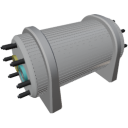
| Component | Electrolyser |
|---|---|
| Module | ARCHEAN_chemical |
| Mass | 500 kg |
| Size | 100 x 100 x 200 cm |
| Push/Pull Fluid | Initiate Push/Pull |
Description
The electrolyser is a component that allows the dissociation of water into hydrogen and oxygen.
Usage
The electrolyser requires high voltage energy input and up to 16 MW during operation. It produces linearly proportional to the amount of available power, up to a maximum of 1 kg of water per second at 16 MW, which is about 40 kWh per kg of hydrogen. It needs at least 1 kW to run: below that threshold it does nothing.
To start the electrolysis process, simply connect a water source to its blue input port. This source can come from a fluid port submerged in water to directly extract water from the sea, for example, or a tank containing water.
The produced hydrogen and oxygen can then be collected respectively from the yellow (H2) and cyan (O2) output ports.
Production
The electrolyser can process up to 1 kg of water per second, providing approximately 0.9 kg of oxygen and 0.1 kg of hydrogen per second.
When both output tanks are full, the electrolyser idles on 50 W and restarts by itself as soon as one of them accepts gas again.
List of inputs
| Channel | Function | Range |
|---|---|---|
| 0 | Power throttle, fraction of the rated 16 MW (0 = off, 1 = everything the supply offers) | 0.0 to 1.0 |
List of outputs
| Channel | Function |
|---|---|
| 0 | Consumed power (Watts) |
| 1 | Water processed (kg/s) |
| 2 | Hydrogen produced (kg/s) |
| 3 | Oxygen produced (kg/s) |